24/7 Emergency Plumbing in St. Louis, MO
When a lateral collapses under a Soulard alley or a supply line splits in an unheated Dogtown garage at 2 a.m., you don't need a call center in another state. Arch Louis Plumbers has delivered emergency plumbing St. Louis MO homeowners and businesses actually rely on since 1990 — 50 skilled professionals, 10 fully equipped vans, and city-licensed crews who know the difference between a vitrified clay lateral in Dutchtown and an Orangeburg line in Affton before they ever pull a shovel. Burst pipes, sewer backups, water heater failures, gas line leaks, commercial drain emergencies. Every hour, every neighborhood, every day of the year.
Call a Licensed St. Louis Plumber Now (314) 881-9997Request Emergency Service
Fill out the form below and we'll contact you immediately!
Why Act Before St. Louis's First Hard Freeze?
St. Louis averages 15 to 20 nights below freezing each winter, with stretches that drop below zero — and the damage almost never starts in the heated part of the house. It starts in the places nobody insulated: crawl spaces under century-old brick, detached garages, unconditioned basements in two-family flats, exterior hose bibs on the north wall, and the vulnerable run of copper that crosses an uninsulated joist bay.
During the January 2026 cold snap, area plumbers reported roughly double their normal overnight emergency volume, with unconditioned spaces the dominant failure point. In extreme wind chill, an exposed line can freeze in about six hours — faster than most people notice a pressure drop. The window between “it's cold out” and “there's water pouring through the kitchen ceiling” is shorter than almost any homeowner expects.
Pre-season work costs a fraction of emergency work. Insulating a crawl space run, replacing a failing frost-proof sillcock, or repiping a corroded galvanized section in October is scheduled labor at standard rates. The same job in January, at midnight, with water already in the basement, is not.
Book a Pre-Winter Plumbing Inspection → Written Report Within 24 Hours
Why Do St. Louis Pipes Burst After the First Hard Freeze?
Water expands roughly nine percent as it freezes, and in a closed pipe that expansion has nowhere to go. Pressure builds between the ice plug and the closed fixture downstream until the weakest point in the run gives way — usually a soldered joint, a threaded fitting, or a section of galvanized steel already thinned from decades of internal corrosion.
That last part is why St. Louis burst rates run higher than newer metros. This city has one of the oldest housing stocks in the country. Galvanized supply lines corrode from the inside out, losing diameter and wall thickness long before any homeowner sees a drip. A pipe that has been quietly rusting since the Eisenhower administration does not need a hard freeze to fail — it needs an excuse.
The second failure pattern is timing. Pipes rarely burst while frozen. They burst on the thaw, when the ice plug releases and full line pressure hits a split that was already there. That is why so many St. Louis emergency plumbing calls arrive the morning after the cold breaks, not during it, and why “the water came back on and then everything flooded” is one of the most common sentences our dispatchers hear.

How Fast Can a 24 Hour Plumber St. Louis Homeowners Trust Actually Arrive?
For most calls inside city limits and the inner-ring county, our target is a technician on site within 60 to 90 minutes of dispatch. Ten vans running from a Downtown West base at 1627 Washington Ave means we are not crossing the metro from a suburban yard to reach Benton Park or Central West End.
Response time depends on three honest variables: where you are, what time it is, and how many calls are already in the queue. A single burst pipe on a Tuesday afternoon in The Hill is a fast dispatch. A regional freeze event or a flash flood that drops seven inches in five hours — as St. Louis saw in July 2022 — puts every plumber in the metro in triage. We tell you your actual position in the queue when you call. We do not promise thirty minutes and show up at four in the morning.
What you can do in the meantime matters more than most people realize:
- Water still running: shut the main. In most St. Louis brick homes it is on the basement wall closest to the street, usually within a few feet of the water meter or the meter pit location.
- Sewage backing up: stop all water use in the building immediately — every flush, every load of laundry adds to what is coming up the floor drain.
- Gas smell: leave first, call from outside, then call Spire.
- Water near electrical: kill the circuit at the panel before you step in it.
What Should an Emergency Plumber St. Louis MO Residents Call Do First When the Basement Backs Up?
A backup is a sequence, not a single repair, and the order matters. Done correctly, an emergency plumber St. Louis MO property owners hire works through three phases:
Stop and contain
Halt all water entering the system, isolate the affected area, and determine whether the surcharge is on your side of the line or MSD's. That single determination decides who pays, and it is the question we answer first — not last.
Clear and diagnose
Cable the line to restore flow, then run a camera. Clearing without scoping is the most expensive mistake in this market. A snake through a root mass in a clay lateral buys you four months. Video tells you whether you are looking at roots at a joint, a bellied section, a collapsed Orangeburg run, or a blockage that was never yours to begin with.
Verify and document
Re-camera after clearing, record the footage, measure and mark the defect location from a fixed reference, and put it in writing. If you are going to file with MSD, apply to a lateral program, negotiate with a seller, or make an insurance claim, undocumented work is worth almost nothing.
For sewage that has already reached living space, phase one also triggers our emergency cleanup services St. Louis MO homeowners need before restoration can begin — extraction, antimicrobial treatment, and moisture mapping, handled the same night rather than scheduled for a week later.
How St. Louis Plumbing Actually Fails — and Why We're Built for It
Every metro has a signature failure profile. Ours is written into the housing stock, the soil, and a sewer system that predates the automobile in parts of the city.
Why Arch Louis Plumbers Wins — City-Licensed, St. Louis-Tuned
Most plumbing companies operating here are running national playbooks. You can tell within two paragraphs: they warn you to watch your water bill for a spike. That advice is functionally useless inside St. Louis city limits, because roughly 82,000 water accounts are still unmetered — billed at a flat rate calculated from room count, fixture count, and lot frontage. A running toilet or a slab leak can cost you nothing on paper for a year while it quietly saturates your foundation.
We build around the questions this market actually generates: Who owns the lateral? Does the $28 line on my property tax bill cover this? Is my line clay, cast iron, or Orangeburg? Will fixing this trigger a mandatory meter? Those are the questions, and a company that has been working these blocks since 1990 answers them without looking anything up.
Pipe Expertise — What's Actually Buried Under Your St. Louis Home
Age tells you the material, and the material tells you the failure mode.
- 1880s–1920s: Lead then galvanized supply; 4-inch cast iron soil stack; vitrified clay lateral in three-foot sections. Failure: root intrusion at mortar joints, stack stress fractures, lead-oakum hub leaks.
- 1930s–1960s: Galvanized supply; cast iron waste; clay transitioning to cast iron lateral. Failure: internal corrosion, scale restriction, rust nodules.
- 1950s–1970s: Galvanized to copper; cast iron waste; Orangeburg lateral. Failure: the wood-pulp-and-tar pipe deforms into an oval and collapses at 60 to 75 years. Concentrated in Affton, Lemay, Mehlville, Florissant, Overland and Crestwood.
- 1970s–1990s: Copper and polybutylene supply; PVC/ABS waste. Failure: polybutylene fitting failure, pinhole copper leaks.
- 2000s onward: PEX and copper; PVC throughout. Failure: fitting workmanship, freeze in unconditioned runs.
We identify the material on camera before quoting, because the repair method is not negotiable once you know what you have. Cured-in-place lining is excellent in a structurally sound clay line and completely wrong in a collapsed Orangeburg run.
Freeze-Rated Repairs & Overhead Sewer Conversions
Repairs here have to survive a freeze-thaw climate, saturated expansive clay, and in much of south St. Louis, karst limestone with underground voids that shift what sits above them.
- Insulated and heat-traced runs in crawl spaces, garages and unconditioned basements — not foam sleeves that fall off by February.
- Frost-proof sillcock replacement with proper interior pitch so the barrel actually drains.
- Overhead sewer conversion — the definitive St. Louis backup fix, eliminating below-grade gravity connections entirely so a surcharged main physically cannot reverse into your basement.
- Backwater valve installation where an overhead conversion isn't warranted, with a maintenance schedule, because a neglected valve that sticks closed blocks your own drainage.
Landlord, Multi-Unit & Property Management Workflows
St. Louis has an enormous two-family flat and small multi-unit stock, much of it owned by people who don't live in the building.
- Time-stamped photo documentation on every visit, with technician initials and scope of work.
- Remote coordination — lockbox codes, tenant contact protocol, and direct-to-owner reporting so you are not relaying diagnostics through a tenant.
- Occupancy-permit-aware repairs for City properties, so a plumbing fix doesn't stall a re-occupancy inspection.
- Per-unit cost allocation on invoices for owners managing multiple addresses.
STR & Downtown Loft Host Rescue
A plumbing failure in a short-term rental is a refund, a one-star review, and a blocked calendar.
- Priority dispatch windows where routing permits, to cut turnover downtime.
- Low-visibility arrivals and interior-focused work in shared loft buildings along Washington Avenue and Laclede's Landing.
- Before-and-after documentation formatted for guest and platform dispute resolution.
- Familiarity with the shared-stack and shared-lateral realities of converted warehouse buildings, where your unit's problem often is not your unit's pipe.

Health Risk: Sewage Exposure, Lead Service Lines & Water Safety in St. Louis
Raw sewage in a basement is a biological hazard, not a cleaning problem. Category 3 water carries bacteria, viruses, and parasites, and porous materials it contacts — carpet, pad, drywall below the waterline, insulation, particleboard — generally cannot be salvaged. The greater danger is what happens after: contaminated material that stays wet grows mold within 24 to 48 hours in a St. Louis summer.
This is why we treat backup response as a health service. Extraction, antimicrobial application, controlled demolition of unsalvageable material, and documented moisture readings — not a mop and a fan. Whether the call is a city two-family flat or a St. Louis County emergency plumbing dispatch, the protocol is identical, and we strongly discourage DIY cleanup of sewage-contaminated space without proper protection.
Lead is the second exposure risk, and it is specific to this city. Lead service lines were legal to install in St. Louis until 1983. Of roughly 113,000 service lines in the city, about 9,000 are confirmed lead, 46,000 confirmed non-lead, and roughly 58,000 remain unidentified. The private-side line is the property owner's, and any disturbance — a repair, a partial replacement, a nearby main break — can temporarily increase lead release.
- Check your address on the City Water Division's Lead Service Line Public Viewer before assuming you are clear.
- Free water testing is available from the Water Division at (314) 771-2255.
- Never do a partial lead replacement. Replacing only one side can make exposure worse.
- We hold EPA Lead-Safe certification and follow full-replacement protocol with post-work flushing guidance.
And water reliability itself is now a recurring local issue. The boil advisory of August 2026 affected an estimated 50,000 residents for roughly 25 hours after storm-driven power problems at the Chain of Rocks plant. After any advisory, flush fixtures thoroughly, replace point-of-use filters, drain and refill ice makers, and consider a water heater flush if sediment was disturbed.
Code-Compliant, City-Licensed Plumbing Across St. Louis City & County
Missouri does not license plumbers at the state level. St. Louis City and St. Louis County run entirely separate frameworks — separate boards, separate exams, separate permits. A County license does not authorize work inside city limits, and plenty of homeowners find this out only when a permit gets rejected.
Under RSMo 341.170, a master plumber must be at least 25 with three or more years as a licensed journeyman; a journeyman must be 21 with five years as an apprentice. Inside the city, plumbing permits are issued only to contractors certified by the City of St. Louis Building Division and registered through the STL City Permits system.
The word that matters locally is drainlayer. The City's Board of Examiners for Plumbers and Drainlayers seats a master plumber, a master drainlayer, a journeyman plumber, a Certified in Plumbing Design holder, and a Plumbing Division representative. Lateral and sewer work falls under drainlayer scope — which is why “are you a licensed drainlayer?” is a better screening question than “are you licensed?”
What this means for you in practice:
- Water heaters, gas lines, repipes and sewer work require permits and inspection in the city. A contractor who offers to skip the permit is creating a problem for your next appraisal or sale.
- Board Bill 28, approved June 2026, now requires a water meter on new construction, rehabs needing a new service line, and service line repairs already involving excavation and replacement. Property owners pay for installation; the Water Division owns the meter afterward. We tell you before we dig whether your job triggers it.
- Backflow assemblies on commercial properties and irrigation systems require annual certified testing. We hold ASSE Backflow Prevention certification and file the paperwork with the water purveyor.
What Is the Most Effective Way to Stop a Sewer Backup for Good?
Clearing a line ends today's emergency. It does not stop the next one. Permanent prevention comes down to choosing correctly between three levels of intervention.
Level 1 — Line restoration
Hydro jetting scours the pipe wall back to full diameter, which cabling does not do. Appropriate when the pipe is structurally sound and the problem is grease, scale, or fine roots. Not appropriate for a compromised line — high-pressure water in a fractured clay pipe can finish what the roots started.
Level 2 — Structural repair
Cured-in-place pipe lining rebuilds a structurally sound but leaking line from the inside, with no trench. Spot repair or full trenchless replacement handles collapsed sections, severe bellies, and Orangeburg. This is where accurate camera diagnosis pays for itself several times over.
Level 3 — System reconfiguration
A backwater valve blocks reverse flow at a single point; it is the lower-cost option and it demands annual maintenance. An overhead sewer conversion re-engineers the building's drainage so basement waste is collected in a sealed ejector basin and pumped up to a discharge point above the basement floor, with storm water handled separately by a sump system. It is the higher investment and the only approach that removes the gravity path entirely.
If your basement has backed up more than once, you have a system problem, not a clog problem, and repeated cabling is the most expensive way to avoid solving it.
How We Compare to Typical St. Louis Plumbing Companies
Here is what we commit to in writing, so you can hold any contractor — including us — to the same standard.
| Standard | National Franchise Model | Owner-Operator Model | Arch Louis Plumbers |
|---|---|---|---|
| Camera verification | Often an upsell | Varies by operator | Standard on every sewer call, footage provided |
| Local material knowledge | Generic national script | Usually strong | VCP / Orangeburg / cast iron identified before quoting |
| Permit handling | Sometimes subcontracted | Sometimes skipped | Pulled and inspected, City or County as applicable |
| Pricing | Flat-rate book, quoted on site | Verbal estimate common | Written estimate before work begins |
| Overnight coverage | Answering service to morning | Owner's cell, if awake | Ten vans, staffed dispatch, 24/7/365 |
| Commercial capability | Separate division, slower | Often unavailable | Grease traps, backflow, multi-unit in house |
| Documentation | Invoice only | Invoice only | Photo report, camera footage, defect location marked |
We are not claiming every other company is bad. We are claiming these seven items are measurable, and you should ask for all of them from whoever you call.
What Makes Us Different
Thirty-six years in one metro produces a specific kind of knowledge that does not transfer from anywhere else.
- City and County licensed. Master Plumber and Journeyman Plumber credentials, with permits pulled in the correct jurisdiction every time.
- Certified in Plumbing Design (CPD). A design-level credential the City's own Board of Examiners seats a chair for — and one almost no residential competitor in this market holds.
- Camera-first diagnosis. We do not quote a sewer repair we have not seen.
- Full commercial capability. Grease trap service and FOG compliance, certified backflow testing, commercial hydro jetting, commercial water heaters and boilers — the same trucks, the same night.
- Written estimates, always. Scope, price and timeline in writing before a tool comes off the van.
- Fully insured. General liability, workers' compensation, commercial auto, inland marine tool and equipment coverage, and a business owners policy. Certificates available on request.
- Trenchless-capable. Lining and pipe bursting where the line and the site allow, so we are not tearing out your driveway by default.
- Documented work. Photos, footage, and defect locations marked from fixed references, because you may need to prove what happened to MSD, an insurer, a buyer, or a seller.
Is Calling a Licensed St. Louis Emergency Plumber Actually Worth It?
For a genuine emergency in this housing stock, yes — and the reason is diagnostic, not mechanical.
A hardware-store auger can clear a soft blockage in a branch line. It cannot tell you that the reason your floor drain surcharges every heavy rain is a bellied clay lateral eleven feet from the cleanout, or that your neighbor's silver maple has colonized a joint under the alley, or that the pipe you are snaking is Orangeburg and one more pass will finish it. Chemical drain openers are worse: they generate heat inside cast iron and PVC, rarely reach a root mass, and turn a routine service call into a hazardous one for whoever opens the line next.
The financial case is straightforward. Emergency water damage is largely a function of duration. A supply line running unnoticed for six hours is a different insurance claim than one caught in forty minutes. And in a city where most homes have no water meter to warn you, duration is exactly the variable nobody has visibility into.
The bottom line: a general contractor treats plumbing as one trade among many. We treat it as the only trade that matters — and in a market this old, that difference shows up in the diagnosis, not the invoice.
Before & After Emergency Plumbing in St. Louis — Real Homes, Real Results
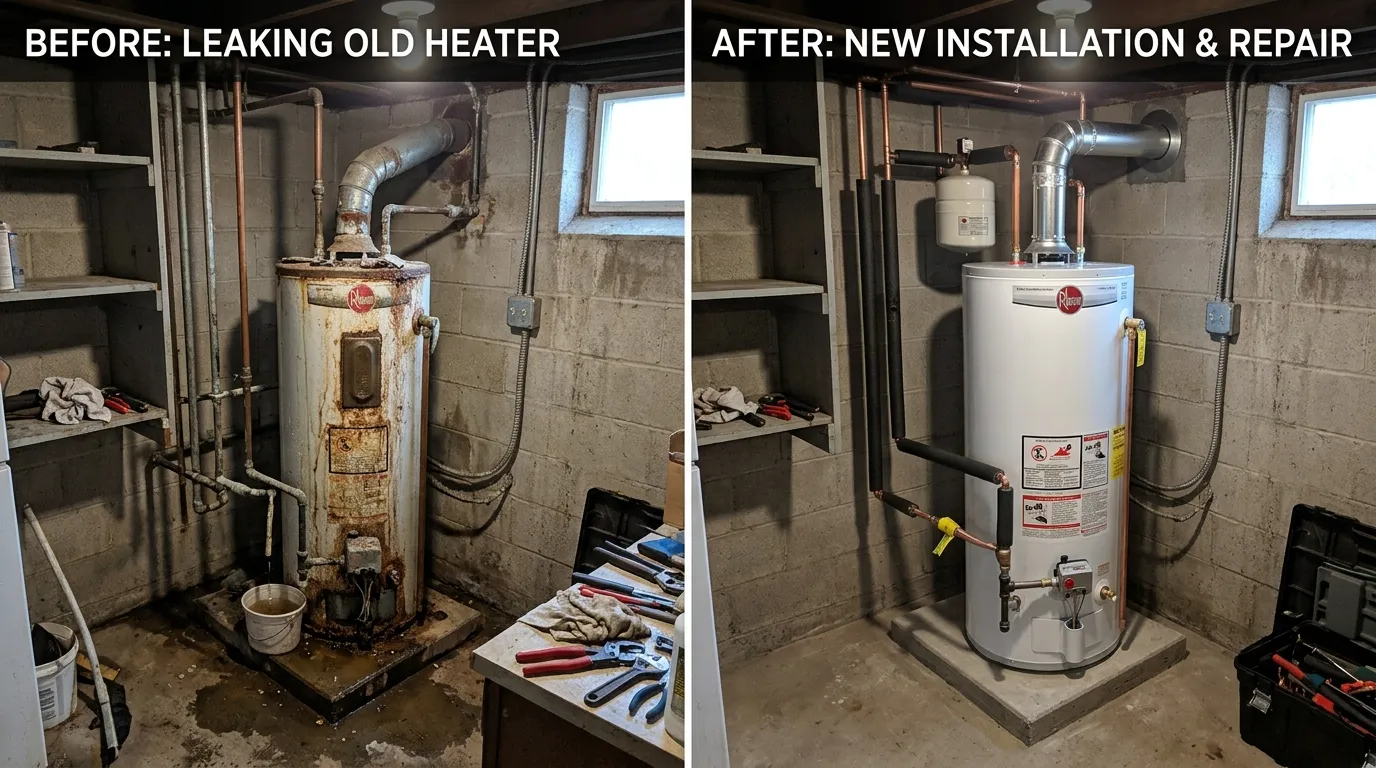
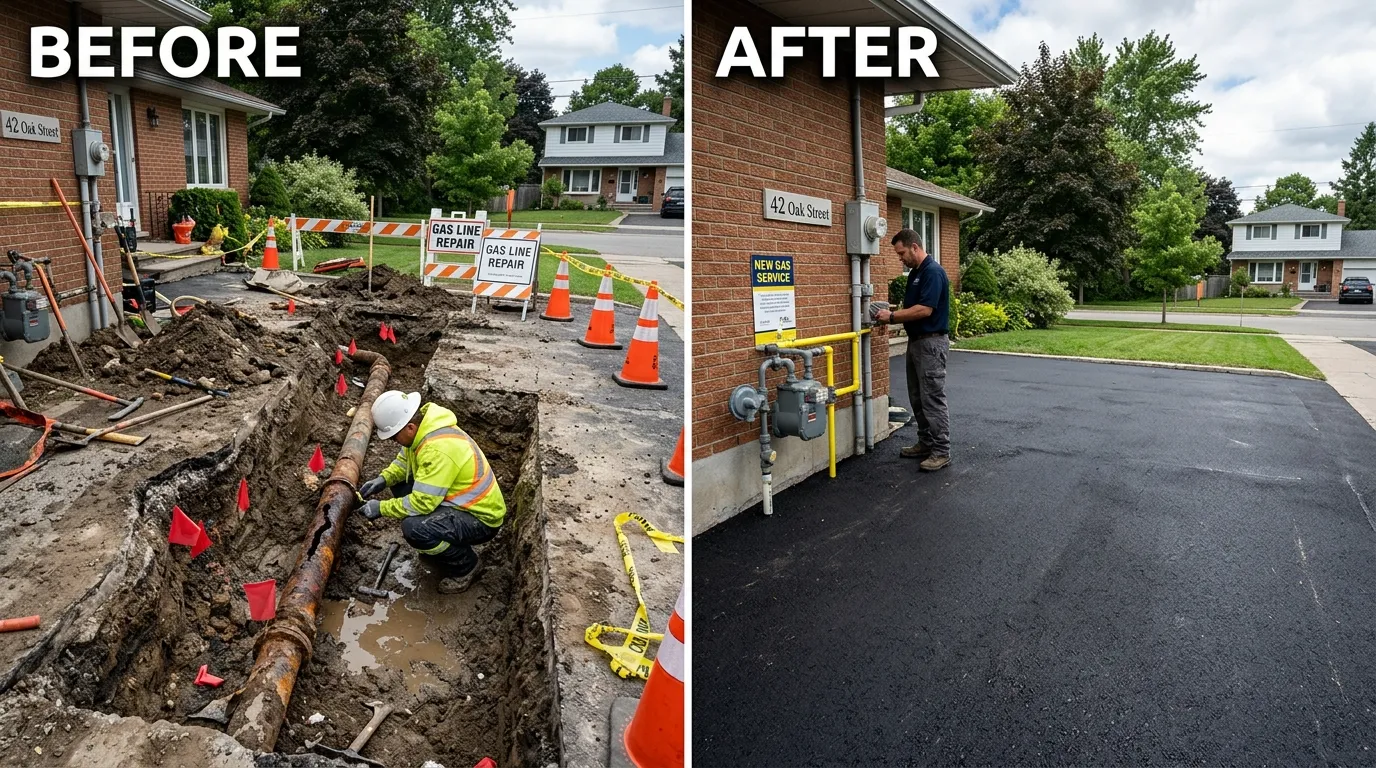
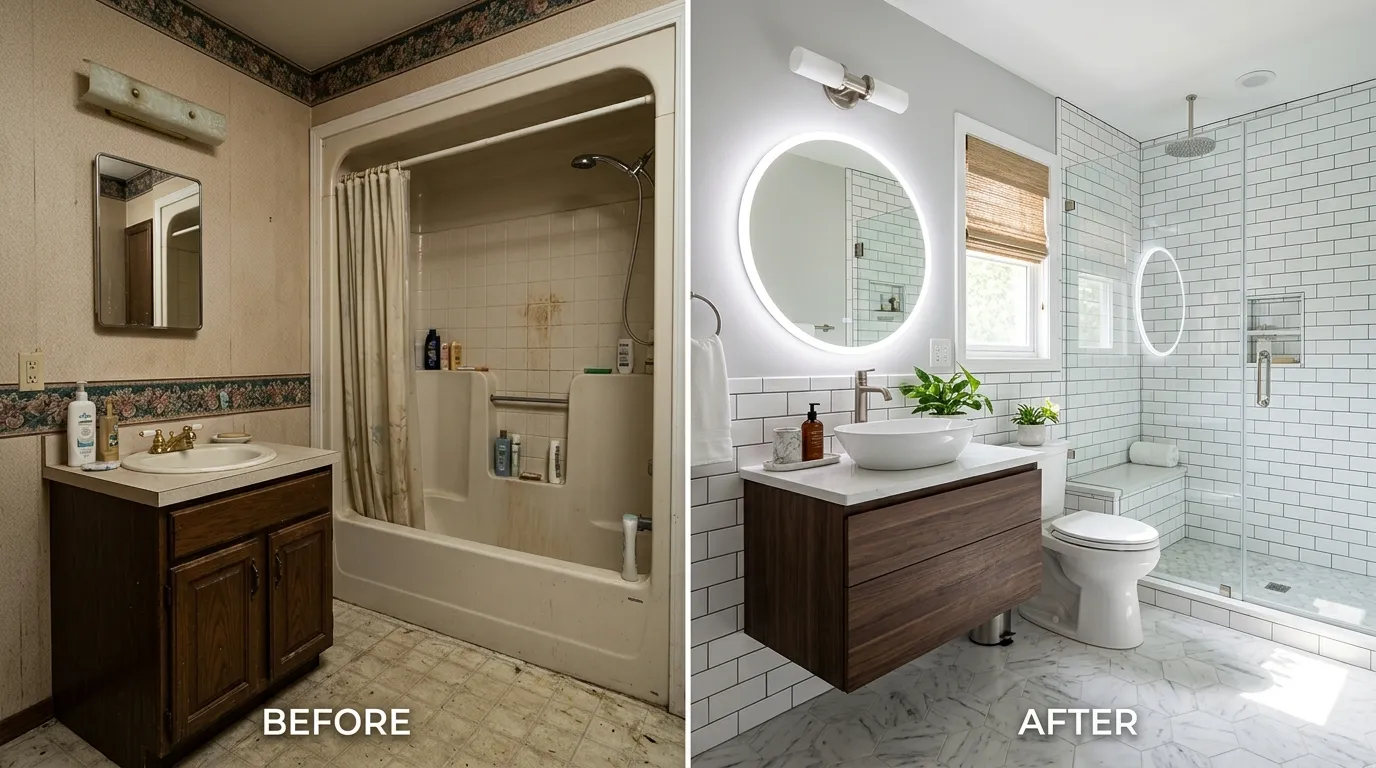
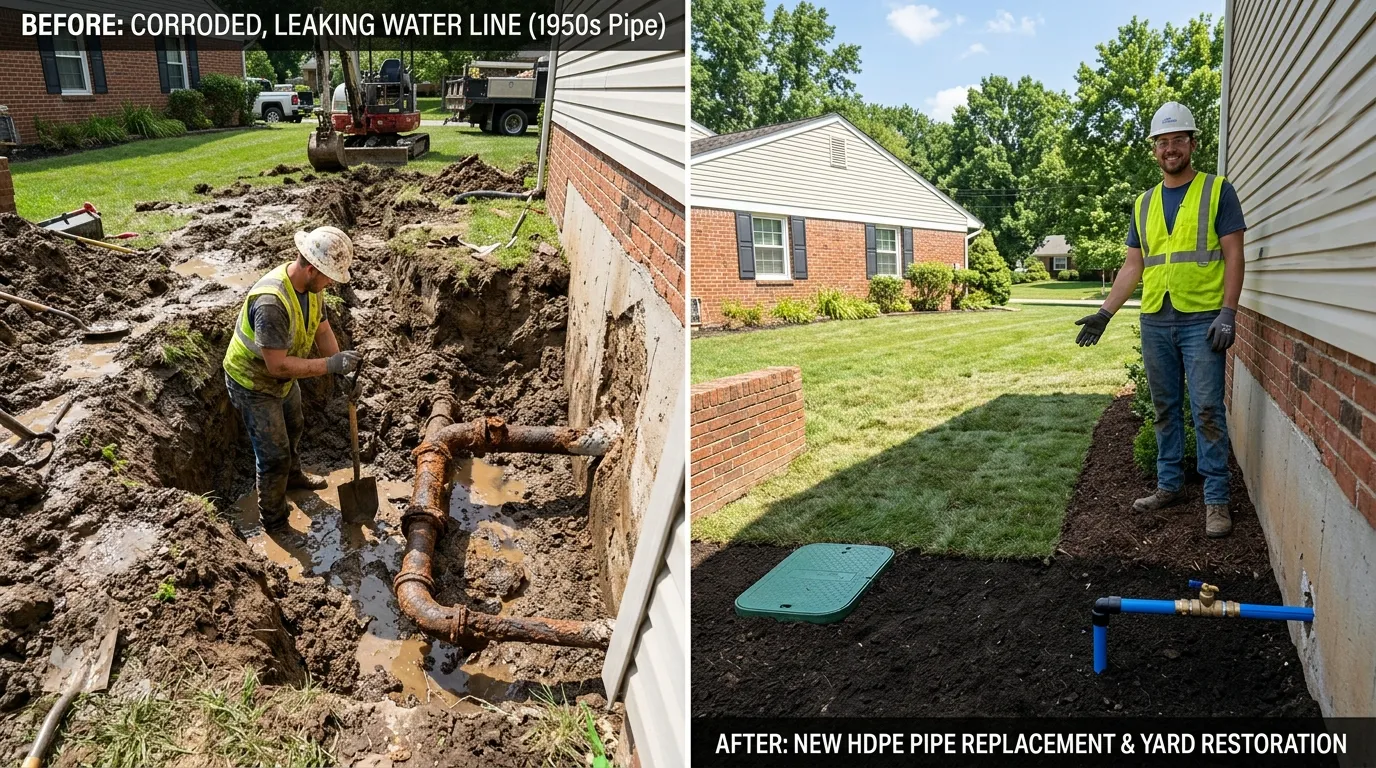
We document projects rather than buy stock photography. Our before-and-after work shows the conditions that actually exist under St. Louis properties: root masses recovered from clay laterals, deformed Orangeburg sections pulled from 1950s subdivisions, corroded galvanized runs cut out during repipes, cracked cast iron soil stacks in pre-1970 flats, finished overhead sewer conversions with the ejector basin and discharge line in place, and grease trap servicing at commercial kitchens.
Every project image is paired with the diagnostic camera footage that justified the repair, the permit where one was required, and the post-work verification scope. If we say a line was restored to full diameter, there is video showing it.
The St. Louis Plumbing Emergency Calendar — Season by Season
Emergency volume in this market is predictable enough to plan around. Here is the year as our dispatch board actually sees it.
December–February (Hard Freeze)
Fifteen to twenty nights below freezing, with sub-zero stretches. Failures concentrate in unconditioned space — crawl spaces, detached garages, exterior walls on the north side, and hose bibs left connected to a hose. The dangerous window is the thaw, not the freeze.
- Burst supply lines, split hose bibs, and frozen sections in uninsulated joist bays.
- Water heater failure spikes as inlet temperatures drop and demand rises.
- Boiler and steam system failures in century homes and older commercial buildings.
Best action now: insulate exposed runs, disconnect hoses, and know where your main shutoff is before you need it in the dark.
March–June (Storm & Saturation Season)
Severe storms, tornado season, and ground that stays saturated for weeks. Expansive clay swells and shifts, stressing laterals and foundation penetrations.
- Sump pump failures and sump pump overwhelm — the single most common spring call.
- Backups where storm and sanitary flows combine and surcharge the system.
- Power-loss failures where the sump has no battery backup.
Best action now: test the sump, verify the check valve, and add battery backup before the first severe weather day.
July–August (Flash Flood, Heat & Grease Season)
The most volatile stretch of the year. St. Louis recorded 7.02 inches in five hours in July 2022, breaking a record set in 1915. Grilling and entertaining season simultaneously drives fats, oils and grease into residential and commercial lines.
- Flash-flood basement intrusion and sanitary surcharge.
- Grease blockages — a March 2026 backup in Green Park produced about three buckets of grease from a 400-foot reach of eight-inch line, in a neighborhood sitting just downstream of a restaurant corridor.
- Water heater failure from thermal load and sediment in hard water.
Best action now: schedule commercial grease trap service on a real interval, and never put cooking grease down a residential drain.
September–November (Root Season & Pre-Winter Prep)
Trees push root growth toward moisture as they prepare for dormancy, and clay lateral joints are the wettest thing underground. This is the calmest month-for-month stretch and by far the best time to do preventative work.
- Root intrusion at clay joints — mature oak, sycamore and maple are the usual culprits.
- Pre-purchase and pre-listing lateral scoping ahead of the fall real estate cycle.
- Backflow certification renewals and pre-winter commercial inspections.
Best action now: camera your lateral. Finding a defect in October is a scheduled repair; finding it in January is an emergency.
Scheduling Intelligence — How We Route Across St. Louis
Getting to you quickly in this metro is a routing problem, and we treat it as one.
We plan around the realities that actually slow trucks down here: the I-64 and I-44 corridor at rush hour, the one-way grid downtown, event traffic around Busch Stadium, Enterprise Center and CITYPARK, and Forest Park congestion on event weekends. We account for alley access — a genuinely St. Louis variable, since a large share of city laterals run to a main in the rear alley, and alley condition, width, overhead lines and parked vehicles determine whether a jetter or excavator can physically reach the work.
We also plan for flood-closed roads during heavy rain events, River Des Peres corridor conditions, and the practical difference between a Downtown West dispatch and an Oakville or Chesterfield run. When you call, we tell you which van is closest and what the honest arrival window is.
How Can I Stop Basement Backups From Coming Back?
Prevention here is not a product. It is a maintenance rhythm matched to the age of your system.
- Scope the lateral every three to five years if your home predates 1970, and annually if you have a known defect you are monitoring.
- Hydro jet on a schedule, not on failure — annually for restaurants and commercial kitchens, every two to three years for older residential lines with grease or scale history.
- Never put grease, wipes, coffee grounds or “flushable” products into the system. Wipes do not break down, and they bind with grease into the exact mass that blocks an eight-inch main.
- Maintain the backwater valve annually if you have one. An unmaintained valve is worse than no valve.
- Test the sump and its backup before every spring storm season.
- Flush the water heater annually. St. Louis water runs 140 to 180 ppm hardness, and county and St. Charles supply runs 4 to 13 grains per gallon — sediment accumulation is a certainty, not a possibility.
- Know your program eligibility before you need it. City properties of six units or fewer pay a $28 annual fee toward the Sewer Lateral Repair Program; most county municipalities run their own version with different caps and rules.
Homeowners who follow this schedule call emergency plumbing St. Louis crews dramatically less often — and when they do call, the problem is usually smaller and cheaper.
What We Fix — From Symptoms to Targeted Remedies
No vague marketing. Here is what you are seeing, and what it actually means.
Multiple fixtures backing up at once, or a toilet bubbling when the washer drains — a main line problem, not a fixture problem.
Floor drain surcharge that correlates with rainfall — a surcharge or infiltration issue, not a clog.
Sewer gas odor in the basement — a dry trap, a failed wax ring, a cracked soil stack, or a broken cleanout cap.
Pressure loss across the whole house with no visible leak — corroded galvanized supply, common in pre-1960 homes.
Rust-colored or metallic-tasting water at first draw — internal corrosion or a service line issue worth testing.
Warm spot on a basement slab or the sound of running water with everything off — under-slab leak.
Recurring slow drains in a commercial kitchen — grease accumulation heading toward a full FOG blockage.
Water heater popping or rumbling — sediment hardening on the tank floor.
Every diagnosis is documented with photos, camera footage where applicable, an urgency rating, and a recommended timeline — so you can decide what needs doing tonight versus what can be scheduled.
How Much Does Emergency Plumbing Cost in St. Louis?
Real numbers, because “call for a quote” is not an answer.
| Service | Typical St. Louis range |
|---|---|
| Standard service call / diagnostic | $65 – $300 |
| Standard hourly rate | $75 – $140 |
| After-hours & emergency hourly | $135 – $275 |
| Master plumber hourly | $80 – $200 |
| Drain cleaning / cabling | $150 – $450 |
| Hydro jetting | $350 – $900 |
| Sewer camera inspection | $150 – $400 |
| Sewer lateral repair or replacement | $3,000+ |
| Trenchless lining (CIPP) | $80 – $250 per foot |
| Water heater replacement | $1,200 – $3,500 |
| Backwater valve installation | $2,500 – $6,000 |
| Overhead sewer conversion | $8,000 – $20,000 |
Three things drive your number: access, depth and material. A lateral six feet down in a clear back yard is a different job than the same defect twelve feet down under a driveway with a gas line crossing it. Emergency work generally runs 1.5 to 3 times a scheduled call, and we tell you that before we dispatch rather than after we arrive.
Overall, St. Louis pricing runs roughly 5 to 10 percent below national averages. What varies most in this market is not the hourly rate — it is whether the diagnosis was right the first time.

Our Proven 6-Step Arch Louis Plumbers Process
Phone Triage (2–5 Minutes)
We start by figuring out whether this is a shut-the-water-off-right-now situation. What fixtures are affected, whether water is still moving, how old the house is, whether there is water near electrical, and whether anyone should leave the building. We walk you through the immediate steps while a van is being assigned — not after.
On-Site Diagnosis & Camera Verification
Your technician inspects the affected system, the main shutoff, the cleanout, and the water heater, then runs a camera on any sewer or drain call. We identify pipe material and age, locate and mark defects from a fixed reference point, and determine whether the fault sits on your side of the line or the district's.
Transparent Plan & Written Estimate — What a South City St. Louis Plumber Should Always Give You
You get scope, price, timeline and urgency in writing before work begins, with the camera footage that supports it. If there is more than one legitimate repair path — line it, spot repair it, replace it — you see all of them with the trade-offs, not just the most expensive one.
Emergency Stabilization (Same Visit)
We stop active damage first: isolate the leak, restore flow, secure gas, and begin extraction where water has entered living space. Stabilization happens on the first visit. Permanent repair can be scheduled once the emergency is contained and you have had time to make a real decision.
Permanent Repair & Permitted Work
We complete the repair to code with the correct permit pulled in the correct jurisdiction, and we schedule the inspection. Trenchless methods are used where the line and the site allow. Where excavation is unavoidable, we restore the site — including notifying you in advance if the work will trigger a meter requirement under Board Bill 28.
Verification, Documentation & Follow-Up
Post-work camera verification, pressure testing where applicable, and a complete photo and footage record delivered to you. For lateral work we provide documentation formatted for MSD program submissions, insurance claims, or real estate disclosure. A follow-up check confirms the repair is holding.
What's Included in an Arch Louis Plumbers Emergency Call?
Our call is built to take you from “something is very wrong” to a documented, permanently repaired system.
- Phone triage — immediate safety steps and honest arrival window.
- On-site diagnosis — full system check, not just the fixture you called about.
- Camera inspection — standard on sewer and drain calls, with footage provided.
- Written estimate — scope, price, timeline and options before work begins.
- Emergency stabilization — damage stopped on the first visit.
- Extraction and sanitizing — where sewage or clean water has entered living space.
- Permitted permanent repair — correct jurisdiction, inspection scheduled.
- Verification and documentation — post-work footage, photos, and defect mapping.
- Program guidance — what your municipality's lateral program covers and how to file.
Landlords, Property Managers & STR Hosts — Protect Your Occupancy
A plumbing failure in a rental is a habitability issue with a clock on it. In a short-term rental it is a refund and a review.
- Priority dispatch for managed portfolios and STR properties, with direct-to-owner reporting.
- Tenant coordination handled by us — access, scheduling, and communication, so you are not the middle layer.
- Occupancy-permit-aware repairs for City of St. Louis properties, so plumbing work does not stall a re-occupancy inspection.
- Documentation packages with per-unit cost allocation for multi-property owners.
- Shared-stack diagnosis in converted Washington Avenue and Laclede's Landing loft buildings, where the failure is frequently in common infrastructure rather than the unit.
- Preventative scheduling across a portfolio — jetting, backflow testing and water heater service batched to cut both cost and emergency frequency.
How We Document Every Job — Serving St. Louis City & County Since 1990
Every job log includes dated photographs, camera footage where applicable, technician initials, permit numbers where a permit was required, and a written scope of work. You can verify exactly what was done, when, and by whom.
Arch Louis Plumbers is a locally owned and operated company working out of 1627 Washington Ave in Downtown West. Our technicians are our employees — not a lead-routing network handing your address to whoever bid lowest. That distinction matters when the work needs a warranty call, or when you need someone who remembers the specific line they repaired at your address three years ago.
Fifty skilled professionals. Ten fully equipped service vans. One metro, since 1990.
Our Emergency Plumbing Services in St. Louis
Full-service residential and commercial plumbing, available around the clock.
Emergency & Drain
Water Systems
Fixtures & Interiors
Gas & Mechanical
Commercial Plumbing St. Louis Businesses Depend On
- Commercial drain cleaning and jetting
- Grease trap and FOG compliance service
- Certified backflow testing, repair and replacement
- Commercial water heaters and boilers
- Multi-unit and mixed-use building plumbing
- Restaurant and food service plumbing
- Preventative maintenance contracts
What we don't do — and who to call instead: we do not handle HVAC, electrical, or roofing. Sewer main defects on the district's side of the line are MSD's responsibility, and we will tell you when that is the case rather than quoting you for work you do not owe. Septic service is available only in outlying areas outside the MSD sanitary system.
What's the Least Invasive Way to Replace a Sewer Lateral?
Trenchless, when the conditions allow it — and in this market they often do.
Cured-in-place pipe lining (CIPP) inserts a resin-saturated liner through an existing access point and cures it in place, forming a new jointless pipe inside the old one. No trench, no driveway demolition, and critically, a seamless interior with no joints for roots to re-enter. Best suited to structurally sound clay or cast iron lines with root intrusion or minor cracking.
Pipe bursting pulls a new HDPE line through the path of the old one while fracturing the original outward. This handles collapsed, severely bellied and Orangeburg lines that cannot be lined, and it typically requires only two small access pits.
When open excavation is still the right answer: severe bellies where the grade itself must be corrected, complete collapse with no continuous path for a bursting head, and situations where depth or utility congestion makes trenchless unsafe.
We recommend the least invasive method the pipe will actually support. What we will not do is line a lateral that needs replacing because lining is easier to sell.
Plumbers in St. Louis MO — Service Area Coverage
Our coverage runs across all City of St. Louis neighborhoods — Dutchtown, Tower Grove South, Bevo Mill, Carondelet, The Hill, Soulard, Lafayette Square, Central West End, Downtown and the rest — plus the inner-ring county and the Metro East.
Got Questions?
We are happy to help. If you cannot find what you are looking for, call and we will walk you through your options and the honest cost range before anything is scheduled.
Contact Arch Louis Plumbers
(314) 881-9997
archlouisplumbers@gmail.com
1627 Washington Ave
St. Louis, MO 63103
Open 24 hours, 7 days a week, 365 days a year
Our Service Area
All City of St. Louis neighborhoods, plus Brentwood, Berkeley, Chesterfield, Clayton, Glendale, Manchester, Maryland Heights, Oakville, Shrewsbury and University City in St. Louis County, and Alton and Belleville in the Metro East.
Whether you need a scheduled repair or emergency plumbing St. Louis MO crews can reach tonight, one call gets you a licensed technician, a written estimate, and a straight answer.
Serving St. Louis Homeowners and Businesses Since 1990 — Our Guarantee
We stand behind our work in writing.
- Workmanship warranty on all repairs, with terms stated on your invoice before you approve the job.
- Manufacturer warranties on installed equipment registered on your behalf.
- Permitted and inspected work, so your repair holds up at appraisal, sale, or insurance review.
- No-charge return if a repair we performed fails within the warranty period under normal use.
- Written estimates honored — the price you approve is the price you pay, and change orders require your approval in writing before work continues.
- Fully insured — general liability, workers' compensation, commercial auto, inland marine, and a business owners policy, with certificates available on request.
Company Gallery — Real Homes. Real Repairs. Real Results.
See what is actually under St. Louis homes, and what a permanent repair looks like.
Our gallery features projects completed across the city and county — clay lateral root masses, Orangeburg sections recovered from post-war subdivisions, cast iron soil stack replacements in pre-1970 flats, galvanized-to-copper and PEX repipes, completed overhead sewer conversions, trenchless lining before and after, sump and ejector installations, and commercial grease trap and backflow work.
Every image is tied to its diagnostic footage, permit record where applicable, and post-work verification scope. No stock photography.
What's the Best Emergency Plumber Near Me in St. Louis?
If you are searching at midnight with water on the floor, here is the short answer: call someone licensed in your jurisdiction, who will scope before quoting, and who will put the price in writing before starting.
We handle the full range of what goes wrong here — burst and frozen supply lines, sewer and lateral failures, basement backups, sump and ejector failures, water heater and boiler emergencies, gas line leaks, slab and under-slab leaks, and commercial drain and grease emergencies. Residential, multi-unit, and commercial.
Our coverage runs across all City of St. Louis neighborhoods — Dutchtown, Tower Grove South, Bevo Mill, Carondelet, The Hill, Soulard, Lafayette Square, Central West End, Downtown and the rest — into Clayton, University City, Brentwood, Chesterfield, Maryland Heights, Oakville and the surrounding county, and across the river into Alton and Belleville.
Booking takes about two minutes. You get an honest arrival window, a technician who identifies your pipe material before quoting, a written estimate, and complete documentation of everything done.
Arch Louis Plumbers has been the answer for emergency plumbing St. Louis MO property owners call first since 1990. One number, any hour: (314) 881-9997.
Call a Licensed St. Louis Plumber Now
Get Emergency Plumbing Services in St. Louis Now
Need an emergency plumber in St. Louis MO? Our 50 skilled professionals are standing by 24/7. If you can't find the information you need about our plumbing services in St. Louis MO, please reach out and we'll walk you through all your options.
Contact Arch Louis Plumbers
(314) 881-9997
archlouisplumbers@gmail.com
1627 Washington Ave
St. Louis, MO 63103
24/7 Emergency Service Available
Monday – Sunday: 00:00 – 23:59